Mageia at Chemnitz Linux Days 2017

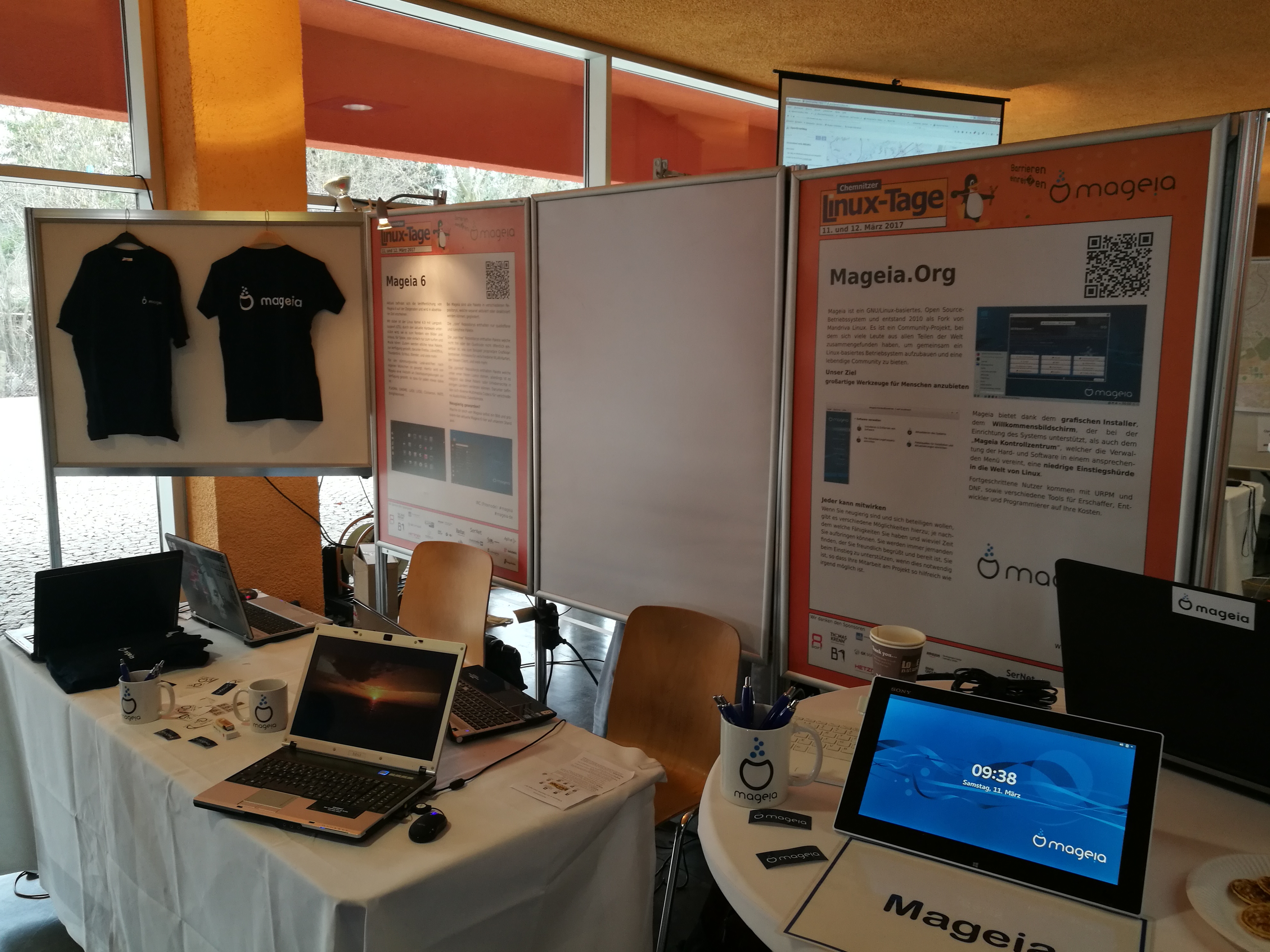
As every year in Spring, the Chemnitz Linux Days (Chemnitzer Linux Tage – CLT) are coming soon and we have the pleasure to showcase our project, our community and our great distribution there. It takes place on the 11th and 12th of March at then central lecture hall of the Technical University of Chemnitz (Germany).
Last year we had some issues in the preparation and even though we had to cancel our booth, some of us managed to present at least a core team. Because of that we are very happy that the organisers still believe in our project and give us again the opportunity to present it, this year with a proper booth!

We want to present our still well working and stable Mageia 5 release as well as the recent snapshots of Cauldron and upcoming Mageia 6. We will have some laptops on which the visitors can test hands-on the system with its different desktops and software. Of course we are also happy to assist in the installation on your own computers as needed (we have also beautiful USB sticks with the Live media for KDE and GNOME, which we give away for a small donation to the project). Finally we would enjoy discussing with you about the community, the project and we are not reluctant to talk about the delay and problems of the recent development.

Please come along, next to our stand you will find a lot of other interesting projects which will present their work. Additionally there are plenty of talks covering the entire spectrum of the open source world. For the children too, there will be a lots of activities and the always well-prepared CLT organisation team will also handle the catering for you and help with accommodation.

We are looking forward to seeing you in Chemnitz and to welcome you at our booth!

Posted in community, events, Mageia, users | 11 Comments

Back from FOSDEM 2017 with new ideas and momentum!

Even though we could not have an official Mageia stand this year, the Mageia community was well represented at FOSDEM 2017 (Free and Open Source Developers’ European Meeting) in Brussels. We had an official talk by Anne and Samuel in the Distributions devroom, an informal Mageia real life meeting, the traditional Mageia dinner and many occasions to gather in small groups to discuss our favourite distro and community.

The Mageia talk: Successes and lessons learned 6 years after forking

Anne Nicolas (ennael) and Samuel Verschelde (stormi) gave an inspiring talk about the current state of affairs at Mageia: What’s our new purpose 6 years after the initial “community rescue” fork of Mandriva? What did we achieve in the Mageia community? What is still to be done or needs to be improved so that we can continue to grow and to improve the distro?

Thanks to the great work of the FOSDEM video team, you can watch the video recording of that talk!

Video of the talk (26 min), in WebM. Try the MP4 if it does not work.

Informal meeting

At the end of the talk, Marja van Waes (marja) invited all interested attendants to join us for our planned meeting in the afternoon. We were maybe 15 Mageians for this meeting, and had two contributors from Fedora and LibreOffice who joined us and gave very good insights on how they address the problems we discussed in their own projects.

This meeting was a great occasion to do an informal review of the current state of the distro and the community (we usually use this opportunity to have the Mageia.Org association’s general assembly, but fearing a lower attendance this year due to the lack of a Mageia stand we planned it for a later online meeting), and especially to discuss all those infrastructure issues that we keep pushing forward by lack of sysadmin time.

This helped build up some momentum and we are already seeing some improvements on various sysadmin tasks (such as improving the granularity of rights so that sysadmin apprentices can access the infra with restricted rights, to help share the load) and new discussions and ideas on long-term changes we want to make for Mageia 7 (such as porting our packages source repository from SVN to Git, or deploying a modern software forge such as Pagure or GitLab CE).

Mageia dinner

Following our tradition, we had a Mageia dinner on the Saturday evening with those that were available. It was a great opportunity to chat about Mageia and various other topics of interest. The service was pretty slow, but that gave us even more time to discuss while we were waiting ;). We really enjoy this yearly dinner, as FOSDEM itself is a very hectic event, so having a slow-paced evening break is very helpful to better get to know the contributors with whom we’re working on the Internet all year long.

This year again, FOSDEM really showed us that having a real-life event where we can meet fellow Mageia contributors really helps to strengthen our community, and speeds up the work on many important tasks. We realise increasingly that face to face communication can be really beneficial to the project, which is why we’re looking into reliable (free software) video-conferencing options so that we could have, from time to time, video meetings about specific topics.

We will definitely be at FOSDEM 2018, hopefully with a stand if there is room for us this time, and likely at many other events all around the world – if you want to represent the Mageia community at a local free software or Linux event, don’t hesitate to get in touch with the Atelier team!

Posted in community, events, Mageia, users | 4 Comments

Weekly roundup – 2017, week 8

So, this weekly roundup is a new thing that we were wanting to try, with the hope that it will bring more attention to the day to day changes in both Mageia 5 and Cauldron, and what the various teams are working on right now.

The big thing going on right now is ISO testing for the next Mageia 6 milestone, sta2 (short for “stabilisation snapshot 2”). New images have been built with fixes for mga#20074, the partition table corruption bug we mentioned in a previous post. If the tests are successful, the release won’t be far away.

There were a few big updates too, Cauldron saw kernel 4.9.12 land whereas Mageia 5 has had kernel 4.4.50 in updates testing, with various bug and security vulnerability fixes. Short of being validated, a new build was made with cherry-picked patches to fix CVE-2017-6074, a critical security vulnerability which was announced yesterday and made the headlines of the specialised press. It will appear on the mirrors after going through QA validation, probably today given its critical nature.

The update of ffmpeg to 3.2.x and the associated other updates and rebuilds in Cauldron is also ongoing; ffmpeg 3.2.4 is available in the testing repositories, and will be moved to release once we’re confident that all reverse dependencies will work with this version or can safely be dropped.

There have also been updates to the NetworkManager stack in Cauldron, and parts of XFCE are being tweaked and updated so that the new ISOs shipping with XFCE give a great experience, more on that to come in a following blog post.

The other big bit of news is that team elections are coming, some teams have already started to candidate and will vote soon, so if you’re involved with any of the teams, look out for the mails about voting.

While not specific to any updates or things that you will see, we had an interesting council meeting on Tuesday where we discussed possible blog posts that we want to write. An interesting part was that we tried some video conferencing after the meeting, and it was good to put faces to names and actually hear voices, so hopefully this will help facilitate some faster decisions and be useful for other meetings and the association’s annual general meeting. On a bigger note, Schultz was disappointed to find out that he was beaten on the hair and beard front…

More seriously, there should be lots more content appearing on Facebook and Twitter, so look out for more things there. Also, a new blog post about the Mageia documentation process was recently published which is a pretty good read giving a good insight into what goes on to make the documentation what it is and the differences between the wiki and the “official documentation” that ships with each release. There are also a list of other blog posts about collaboration with other distros, games and other changes in the distro coming soon, so look out for them too.

As this is the first of these updates, we’d like to hear your feedback on it: was it informative enough, too much information, or anything else that you could suggest?

Posted in Collaboration, community, Mageia, QA, security | 23 Comments

Where does the Mageia Documentation come from?

We asked Lebarhon from the Documentation team to write a bit about the work of the team and the various resources that they created for our users. In this article, he presents their work on the “Official Documentation” and the Mageia wiki.

The Mageia Documentation is made up of two parts: the “Official Documentation and the wiki. The way they are managed is very different.

Official Documentation and Mageia Wiki

Inside the official documentation, we have the Classical Installer help, the Live Installer help and the NetInstall help. This documentation, directly related to the installation process, is updated and shipped with each new Mageia release. The MCC (Mageia Control Center) help also belongs to the official documentation. It is steadily updated and packaged to join the regular downloaded updates. All the “Official Documentation” is written and validated by Mageia teams and then translated into more than 20 languages.

The wiki follows a very different process. Anyone can subscribe for an account and write, improve or translate a wiki page. The writer is generally somebody who masters a subject and wants to promote it (application, game, tool, settings, tricks, information, …). Anyone wanting to translate a page is welcomed to do so. Most of the wiki pages are translated into 1 to 5 languages – the translation process is still unwieldy, we plan to deploy a MediaWiki extension to simplify it (and then encourage more contributors to translate wiki pages). Mageia teams monitor the wiki to ensure that it is working as it should (and especially prevent and remove spam), but they can’t proofread all pages thoroughly.

Who Writes the Official Documentation?

Mageia’s official documentation depends on the involvement of several teams:

  • Docteam, the writers, made up of about 10 people, some of whom are English native.
  • i18n, the translators, made up of 1 to 10 people depending on the language (about 20 languages).
  • Atelier, they manage the publication and the monitoring of the translation progress.

Teams are run by an elected leader and deputy leader. Any new volunteers are of course very welcome.

The Workflow

The official documentation follows a strict process. First, some weeks before a release, Docteam writes and/or updates the texts in English in the Docbook format using Calenco. That includes doing screenshots of the next release (to match the new artwork in the installer and MCC as well as GUI changes), checking and proofreading by a native English speaker. Then, the English original text is published in the supported formats: html, epub and pdf.

Here, Atelier takes charge of the .po conversion and its transfer into Transifex, thanks to homemade scripts. Translators can then do the translations using either Transifex or whatever tool they prefer instead, and also create the translated screenshots to place them into Calenco.

At last, Atelier can publish the documentation for all supported languages in the above formats and integrate it into the new ISOs (here also, using homemade scripts). The final step is different for the MCC help, since it is not shipped with the release but packaged like any other update.

Nothing of all that exists for the wiki. The writing is done by a volunteer whenever and in whatever language they want. Then, improving and translating are done by other volunteers, if any (no deadline). This isn’t to say that useful information can’t be found on the wiki, quite the opposite is true, in fact, there are many useful guides and help pages included there.

The Future of the Documentation

Although working pretty well, the Mageia teams have some ideas to improve the documentation:

  • Going into the documentation in greater depth for the newcomers, by giving more details and troubleshooting help (UEFI, BIOS boot partition, Grub2 settings, Optimus…).
  • There are still some of the MCC tools or their specific features that aren’t documented (as they involve exotic hardware)
  • We would like to ship the ISOs with a massive troubleshooting section aiming to help people with poor Internet connections (poor access to downloads, forums, help, etc.).
  • Recruiting more translators to strengthen the small teams and to offer more translated documentation (mostly in the wiki).
  • Recruit more developers to improve the homemade scripts (for example about the official documentation screenshots management) and to update the wiki software for better multilingual support and a better security management.

There is no good distribution without good documentation in many languages and no good documentation without good and large teams. We are relying on you all.

Posted in Atelier, Collaboration, community, Documentation Team, i18n, team | 14 Comments

So where is Mageia 6?

XKCD image representative of the accuracy of our own estimates?

What our current estimates might feel like

There is no mystery about it, we are totally off schedule. The last preview we published for Mageia 6 was Stabilization Snapshot 1 in June 2016, and Stabilization Snapshot 2 still hasn’t been published, although we have been saying “soon” for weeks, or even months! So what’s going on? Is Mageia dead? Fortunately not. But it’s good that you worry about it because it shows you like your Linux distribution. We need to communicate about the state of things so that you can stop worrying, so here we are.

For months we’ve been saying “the next ISO images will be published within a few weeks”… And that’s still how we see it… And actually lots of ISO images have been made, each one improving over the previous one, and Mageia 6 Stabilization Snapshot 2 will be very different from Stabilization Snapshot 1, because during all this time development has been going on, bugs have been fixed, packages have been updated, artwork has been integrated, etc. The good news is: Mageia 6 is really going to be good. And actually it already is, for all those who already run the packages from cauldron, the development branch. So why not release it now? Well, let’s try to give you some insight.

Summer 2016, the first troubles

After we released stabilization snapshot 1, we naturally went for the next one, although we knew that summer is usually family time for many contributors so that was likely to slow the release down a bit. Unfortunately, that was when one of our packagers, who was responsible for building the Live ISO images, but also worked as a sysadmin on our infrastructure and was of great help for debugging difficult kernel-related bugs, announced that he had to stop contributing for health reasons (he has come back since but had to lower his level of contributions). And we had not prepared ourselves for that so it took us time to get back on our feet. Fortunately, others stepped up to progressively fill this void, and we are now in good shape when it comes to ISO builders and the release team; they were responsible for Mageia 5.1, more on that later.

Independently of that, the number of release-blocker bugs had grown. Most of them belonged in the following categories:

  • Installer bugs.
  • Plasma 5 (successor of KDE 4) bugs, and there were many of them at the time because Plasma was still lacking maturity.
  • A nasty family of bugs where the X server (responsible for the graphical display) would fail to start at boot, giving only a “Good luck” message to the users. Many tried to understand what was going on, without success (until we finally cracked the problem!).

September to December 2016: new schedule and Mageia 5.1

Taking those difficulties into account, we changed the schedule, and decided to release Mageia 6 by the end of 2016, but certainly not later. (!)

Also, we felt that our users had already been waiting too long for the new release (so what should we be saying now!), so we decided that it would be nice to quickly build and release a Mageia 5.1 that would be Mageia 5 with all the updates that had been issued since its initial release. It would be possible to install it on newer hardware thanks to a newer kernel and drivers, and avoid the hassle of having to install loads of updates just after the installation. This was agreed upon at one condition: it should not delay Mageia 6 any further.

But…

That was when our servers chose to have severe hardware issues, and we were unable to build new ISO images (thus delaying the “build ISOs, have QA test them and report bugs, fix bugs, build new ISOs” process) for some time, and then other issues made it so that we could not build both Mageia 5.1 and Mageia 6 ISOs concurrently, as was initially planned. Remember: Mageia 5.1 was not supposed to delay Mageia 6. Well it did because of that. The making of Mageia 5.1, which we thought would be quick and easy, gave us more trouble than expected because of issues with the newer stable kernels (the same newer kernels that make it possible to install Mageia 5.1 on newer hardware).

Finally, we released Mageia 5.1. Phewww. We lost an additional two months on Mageia 6’s schedule.

Here we must clarify something: during the making of Mageia 5.1, only the ISO building team, some packagers, and the QA team were involved. The rest of the packagers, testers and developers still worked on Mageia 6, which got newer versions of Plasma – which allowed it to mature –, GNOME and other desktops, newer kernel, newer Xorg (which brought a nasty regression causing freezes when using Plasma or some other programs such as Chromium or VLC, but which we fortunately managed to help fix upstream in the Xorg project, and that benefited other distros affected by the same bug as well… That’s the free software spirit, we benefit from other peoples’ work, they benefit from ours), and many other newer things, fewer bugs too! The nasty “Good luck” bug was gone, the most annoying Plasma bugs were gone too (except one, still present these days, but we’re on it), several installer bugs were also gone.

We also had the opportunity to set up teams of maintainers for various critical parts of the distribution, something that most packagers and our triage team had been waiting a long time for. This brought the beginning of an answer to the situation where an important contributor stopping contributing for whatever reason would hinder us for a while. People joined the teams and we now have, for example, new people working on kernel packaging, installer development and bugfixing, and ISO building. All is not perfect but it’s moving in a good direction.

2017

In early 2017, the state of the distribution looked solid and QA was almost ready to let the Stabilization Snapshot 2 ISOs be released, thus putting an end to a looooooooong wait. Well, that was before they found a partitioning bug in the installer that was able to break your partition table. A broken partition table sadly means a more or less broken computer, unless you’re technically savvy enough to rebuild it correctly. Most of the time the easiest solution would be to wipe the entire disk (and lose data) and start again. The potential frequency of the bug was too high for us to allow the snapshot to be released to the wider public, even with Erratas and prominent warnings. You could be forgiven for thinking that fixing just one bug would be quick but since we’re all contributing over our free time, it actually takes time to 1) identify the issues 2) write patches 3) have the patches reviewed by another developer 4) build ISO images with the patches integrated 5) test them in various situations and on various hardware 6) find a regression related to the patch 7) write a new patch, etc.

It is not an agreeable situation and one of our priorities for Mageia 7 will be to work on critical paths so that we can solve problems faster without delaying the whole release process. Some of our contributors already kind of specialized in being the oil on the wheels for the rest of the teams, but we can do better (maybe with you?).

Disclaimer

The above history is incomplete, probably subjective (you can probably tell that it’s been written by someone who loves and believes in Mageia’s community), and can’t summarize everything that has been done by all the contributors in all the different teams. The author of this blog post thanks them all and is confident that most of you as readers are probably grateful to them too in spite of our lateness.

The current situation

The current situation is that we have a relatively good patchset to fix a number of installer issues, which have been committed to a testing branch and were successfully tested in pre-testing Live ISOs. Now we are deploying them on the full set of Live ISOs and classical installer ISOs for the QA team to test, which should hopefully be the final build for the Stabilization Snapshot 2.

As soon as we reach a satisfying solution for the partitioning bug, you will be able to resume testing the future Mageia 6. Then we will work as fast as we can to fix the last release-blocker bugs and release Mageia 6 to everybody.

You can help

If you love Mageia like we do and want to help us release it faster (while keeping our high quality standards), we would welcome you in one of our various teams of contributors: packaging, development, QA, ISO testing, communication (!) or any other of the diverse things we do. The contribution page is a good place to start, and you can hop on our IRC channels to discuss how you can help with other Mageia contributors.

Posted in community, release | 31 Comments